
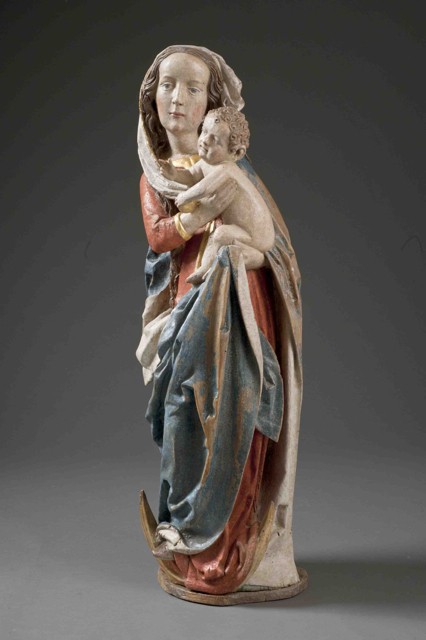
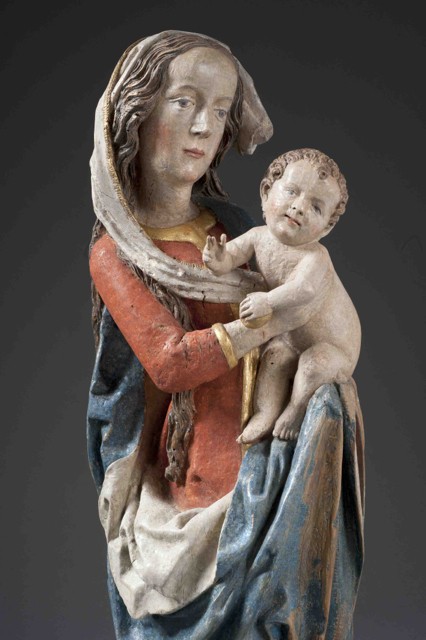
Madonna with Child
Michael Erhart
1440/45 - Ulm - nach 1522
Studio circle
« Madonna and Child»
Swabian, around 1500
lime wood sculpture, in partly original polychrome
Measures: 106 cm / 41.73 in
The Madonna is one of the main subjects of Christian sculpture. The plastic works of art have always been cherished for their great presence and continue to do so. Their illusionism is strong even when less than life size also for the combination with the colour setting. The textiles, the garb, have always been a welcome opportunity for the artist to show off his virtuosity in the design of the folds and pleats in the drapery. The representation of the Madonna is subject to the rules of the iconography of colour, so that the sculpture painter enjoyed less artistic freedom.
The figure of the Madonna on offer originates from the studio of Michael Erhart (around 1440/45 – Ulm – after 1522), one of the most important members of the “School of Ulm” (Hans Multscher, Meister Hartmann, Jörg Syrlin, a. o.). In his travels he visited places like Lake Constance and the Netherlands, after having been trained in the studio of Jörg Syrlin. The “Schöne Ulmerin” (The Beautiful Lady of Ulm, 1475), the figures on the shrine of the High Altar of Blaubeuren (1494) and the Ravensburg Virgin of Mercy (1480) count among his main works. Also well known are the knights at the “Fischkastenbrunnen” (Fish Box Fountain) in Ulm and his works for the choir stalls of the Ulm Minster.
Erhart is deemed to have been influenced stylistically by Nikolaus Gerhaerdt van Leyden (Leiden about 1430, 1473 in Wiener Neustadt/Vienna New Town), who created, among other works, the tomb of Emperor Friedrich (Frederick) III. in St. Stephan’s Cathedral in Vienna. Today this seems less convincing, especially if one compares works by Erhart with Gerhaerdt’s “Dangolsheimer Muttergottes” (Dangolsheim Virgin Mother, 1460/65). It makes more sens to place him near the elder Jörg Syrlin and Hans Multscher, like the latter’s “Schmerzensmann” (Man of Sorrows, Ecce homo) in the Ulm Minster (1429).
The Madonna on offer combines, iconographically, the “Immaculata” (Virgin immaculate) with the Madonna on the Crescent Moon (which one can see rather often, as both are complimentary aspects of the image of Mary). So there is a connection to the Apocalypse (Chapter 12). As were find ourselves in the Late Gothic period, the sculpture has already distanced itself a little from the “Apocalyptic Woman” and is, already, nearer a straight Madonna. The child Jesus shows a deictic gesture (a pointing gesture as a gesture of instruction) and holds, as the (future) ruler of everything, the apple (a symbol for the orbis terrarum).