

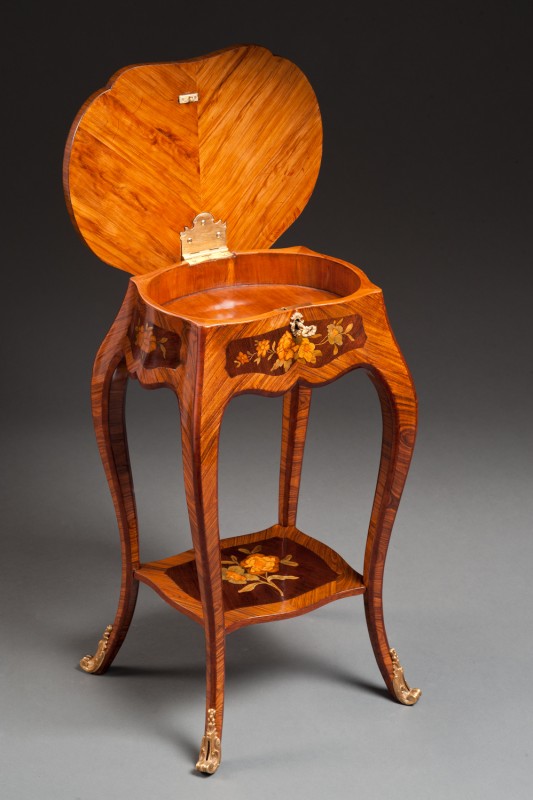
Table en chiffonière
Joh. Friedrich and Heinrich Wilhelm Spindler brothers,
attributed
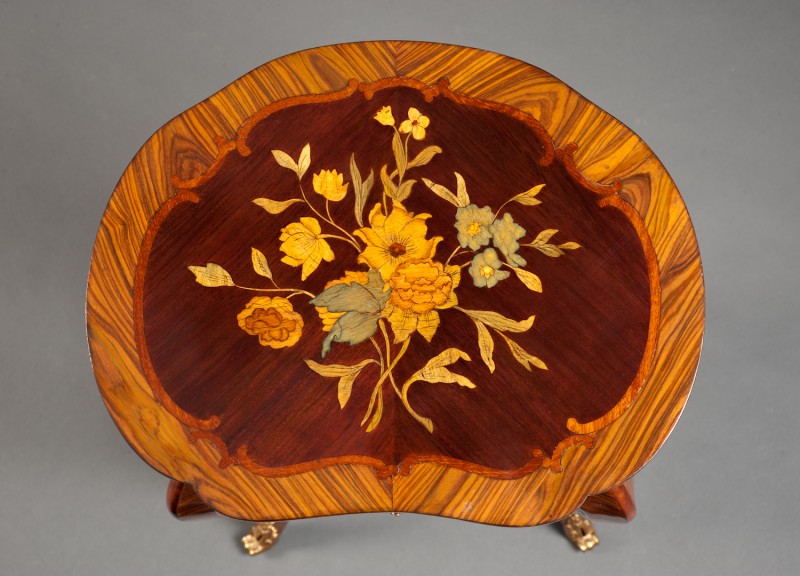
Pine body with marquetry in colored fruitwoods,
kingwood and mahogany veneer,
original bronze mountings and lock
measurements: 66cm x 40cm x 31cm
The Spindler brothers of Bayreuth, later Potsdam, count among the most important cabinetmakers of their era, together with the Roentgen family of Neuwied. When Frederick II (the Great) had the Neues Palais (New Palace) built with its more than 400 chambers, he needed additional cabinetmakers on top of those already employed. Thus "the times of Bayreuth" began in Potsdam.
The Spindler stepbrothers came from a family of carpenters and cabinetmakers in Bayreuth. The elder brother, Johann Friedrich, completed a large commission for a daughter of the Margravine of Bayreuth who died in 1758, Wilhelmine Friederike Sophie, a sister of Frederick the Great: A complete wooden paneling with marquetry, showing landscapes and bucolic scenes, for the Fantaisie palace at Donndorf near Bayreuth. Today it forms part of the collection of the Bayrisches Nationalmuseum in Munich (Bavarian National Museum).
Thirteen pieces are documented for the Neues Palais at Potsdam, but there were more. Ordering war organized less along the lines of individual pieces, more so for whole apartments.
Around 1768 two marquetry panels were created by the two brothers, who each ran their own workshop, for the chambers of Prinz Heinrich (Prince Henry). They were also responsible for the equipment of the meeting rooms facing the garden and the guest rooms facing the court of honor. Johann Friedrich also created a writing table and a chest of drawers each for two rooms of the "Unteren Roten Kammern" (Lower Red Chambers). The writing table was "in red rosewood veneer, in the panel of the middle filling architectural perspective (…) all inlaid piece by piece and nothing engraved, even the faces of the applied figures were inlaid, and then the two side fillings with flowers and landscapes, where there were tow self-opening drawers." The marquetry is related to that of Fantaisie Palace.
It was not unusual to have a writing table in a bedroom. When the more elaborate version of a special writing cabinet was not chosen, the bedroom was the room to which one could withdraw relatively undisturbed, to, among other things, finish paper work.
The younger brother Heinrich Wilhelm Spindler d. J. created, among other furniture, ebony cabinets (around 1767) for the lower Princes' quarters as well as, in 1767, an "urn" chest of drawers with marquetry influenced by Dutch cabinetmakers, which also sports quotations from Mannerist motifs.
It is impossible today to find out who exactly designed the pieces of furniture. Besides the ebenists there also were designers, like the Hoppenhaupt brothers, Johann Christian the Younger (1719-1778) and Johann Michael (1685-1751). Johann Christian Hoppenhaupt however, had a tendency towards opulence, so that one is tempted to see the more sober hand of the cabinetmaker at work in this fine piece of furniture. The designs of the elder Hoppenhaupt (for the most part published in 1750) partly were "untidy", not very organic, which does in no way match the refined broken symmetry of this piece of furniture.
Furniture by the Spindler brothers from the Potsdam period is hard to find. The small saloon table, which is also a container, is the epitome of the "naturalistic" rococo in the reign of Frederic the Great.
The overall design is exquisite, and especially elegant by means of the swinging lines and it also demanded high precision because of the custom fit lid on the utensil compartment. The flower decoration is, despite its worked-through density and compactness of composition almost naturalistic in design and far removed from the porcelain-decoration of the time, which almost inevitably followed outer form.
Tables like these were temporary depositories, for reading Books, for instance, could very well be stored in the compartment.
This piece of furniture is not so much a representative piece in the usual sense, rather its importance is derived from the fact that it is a quasi "intimate", private furniture item, which matches the personal taste of the customer and which hasn't lost any of its charm until today.
____________________________
Literature:
Afra Schick: Johann Friedrich und Heinrich Wilhelm Spindler. Die Möbelaufträge Friedrich des Großen für das Neue Palais. Auf: Perspectivia.net. Publikationsforum für die Geisteswissenschaften. Friedrich 300. Colloquien. http://www.perspectivia.net/content/publikationen/friedrich300-colloquien/friedrich-hof/Schick_Spindler
On Schloss Fantaisie:
August Gebeßler: Stadt und Landkreis Bayreuth. Die Kunstdenkmäler von Bayern, Kurzinventare, VI.Band, München 1959
Kai Kellermann: Herrschaftliche Gärten in der Fränkischen Schweiz - Eine Spurensuche. Erlangen und Jena 2008
http://www.schloesser.bayern.de/deutsch/schloss/objekte/bay_fant.htm
Selection of Furniture
Commode Fireplace clock Table de Salon Commode Demi-Lune-Commode Table en chiffonnière Ladies-Voyeuse Banquette Louis XV Encrier Pair of Rococo-mirrors Table en chiffonnière Rococo-console Secrétaire à Abattant Pendule A Pair of Appliques Bureau Plat Commode Louis XV – Pierre Rousselle Satin? and amaranth tric-trac table Coiffeuse en forme de cœur A Set of four Fauteuils Commode Louis XV Tabouret Table Bouillotte et son Bouchon – Louis XVI Secretary A Pair of Fauteuils A Pair of Bergères A pair of Armchairs Bonheur-du-jour A Pair of Consoles